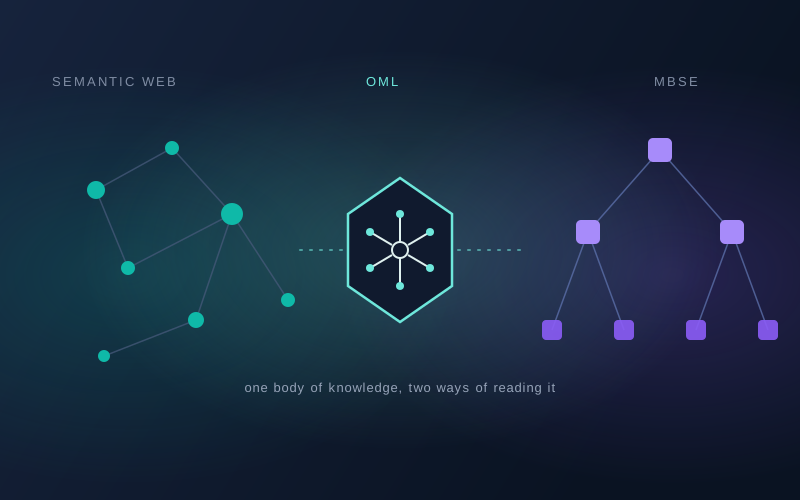
It helps to separate two concerns that often get conflated: semantic interoperability and ontological modeling.
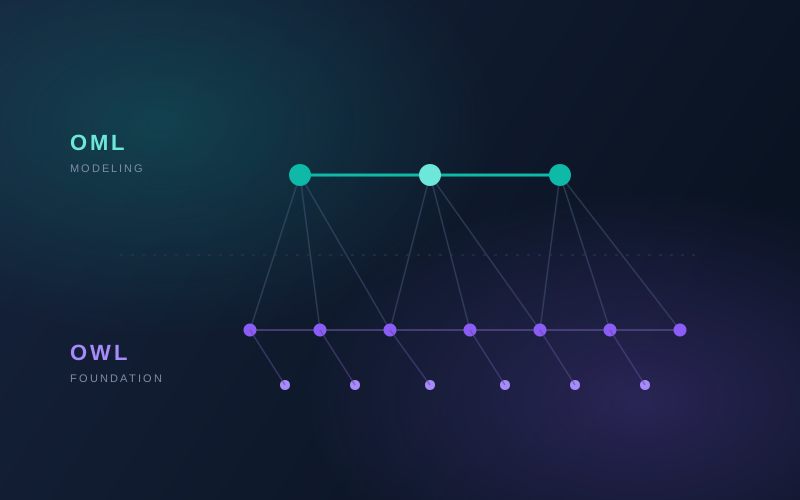
OWL is built for the first. It is a standard logical foundation that lets reasoners, queries, datasets, and tools interoperate around shared meaning. That is enormously valuable, and OML keeps all of it.
Ontological modeling is a different task. It is the engineering work of capturing domain and system knowledge in a structured, consistent, reusable way, and like any engineering task it benefits from a real modeling language: one with the right abstractions, a methodology, and supporting tooling. OWL, as a general-purpose logic, was never meant to be that modeling layer.
OML is. It is a modeling language in its own right, and because every OML construct maps deterministically to standard OWL 2 DL, plus SWRL rules, it delivers semantic interoperability at the same time. Nothing is lost: reasoners, SPARQL, SHACL, and the broader semantic-web ecosystem still apply to what OML produces.
So OML is not an alternative to OWL, and not merely a nicer way to write it. It is the modeling layer for ontological modeling, sitting on OWL as the interoperability layer. Why does that modeling layer need to exist? Because OWL, by design, is unopinionated about precisely the things a systems-engineering effort has to standardize. Here are the four that matter most.
1. Recurring patterns become single constructs, not hand-assembled axioms
Many things an engineer wants to say map, in OWL, to several mutually dependent axioms that have to be written together and kept in sync. Left to convention, different modelers assemble them in different ways, and those inconsistencies surface later as integration pain. OML turns recurring patterns into atomic language constructs with one uniform encoding.
Two examples:
- Reified relations. A relationship with a named forward and reverse role and cardinality characteristics is a single OML construct. In OWL you would build and police several coordinated axioms by hand.
- Physical quantities. Saying a mass is 700 g, in OWL, means adopting an external pattern such as QUDT and policing its use by convention. OML makes quantities, units, and dimensions first-class: you write unit-tagged values, get machine-checked dimensional consistency (so you cannot accidentally add a mass to a length), and it still compiles to the same standard pattern underneath.
The point is not that OWL cannot express these things. It is that OML gives you one correct way to express them, every time.
2. Closed-world checks where engineering expects them
OWL assumes an open world (anything not stated is merely unknown, not false) and does not assume unique names. Both are the right defaults for the open web and the wrong ones for checking a design. The practical effect is that real errors stay hidden: without explicit disjointness, two things you consider distinct can be silently treated as possibly the same, and a missing element is never flagged as missing.
OML handles this at well-defined module boundaries. Its bundle mechanism mechanically adds the closure axioms, so you can reason over a design as a closed system while still connecting to open, shared knowledge elsewhere. You get closed-world rigor without writing and maintaining the closure by hand.
3. An enforced separation of vocabulary from data
OML separates vocabularies (the concepts and relations, your schema) from descriptions (the actual system instances, your data), and it types the import relationships between them: a description uses a vocabulary, a vocabulary extends a vocabulary. In raw OWL this discipline exists only as a convention that nothing enforces, so it erodes over time. In OML it is part of the language, which keeps large models coherent as teams and projects grow.
4. A deterministic subset is what makes real tooling possible
Because OML restricts itself to a deterministic, well-defined subset, you can build the tooling engineering teams actually need. Its textual syntax diffs and merges like source code, so models live in Git and go through pull-request review. Editors and validators can be pattern-aware. Data entry can be unit-aware. Generic OWL tooling, operating at the level of arbitrary axioms, cannot offer any of this.
The trade, and why it is worth it
OML deliberately trades some of OWL’s surface expressivity for uniformity, verifiability, and tool support, while remaining fully interoperable with OWL underneath. For systems engineering, that is exactly the trade you want: a real modeling layer for capturing engineering knowledge, sitting on a standard you never actually leave.
Curious what that looks like in practice? Explore OML Code, or see it in action.