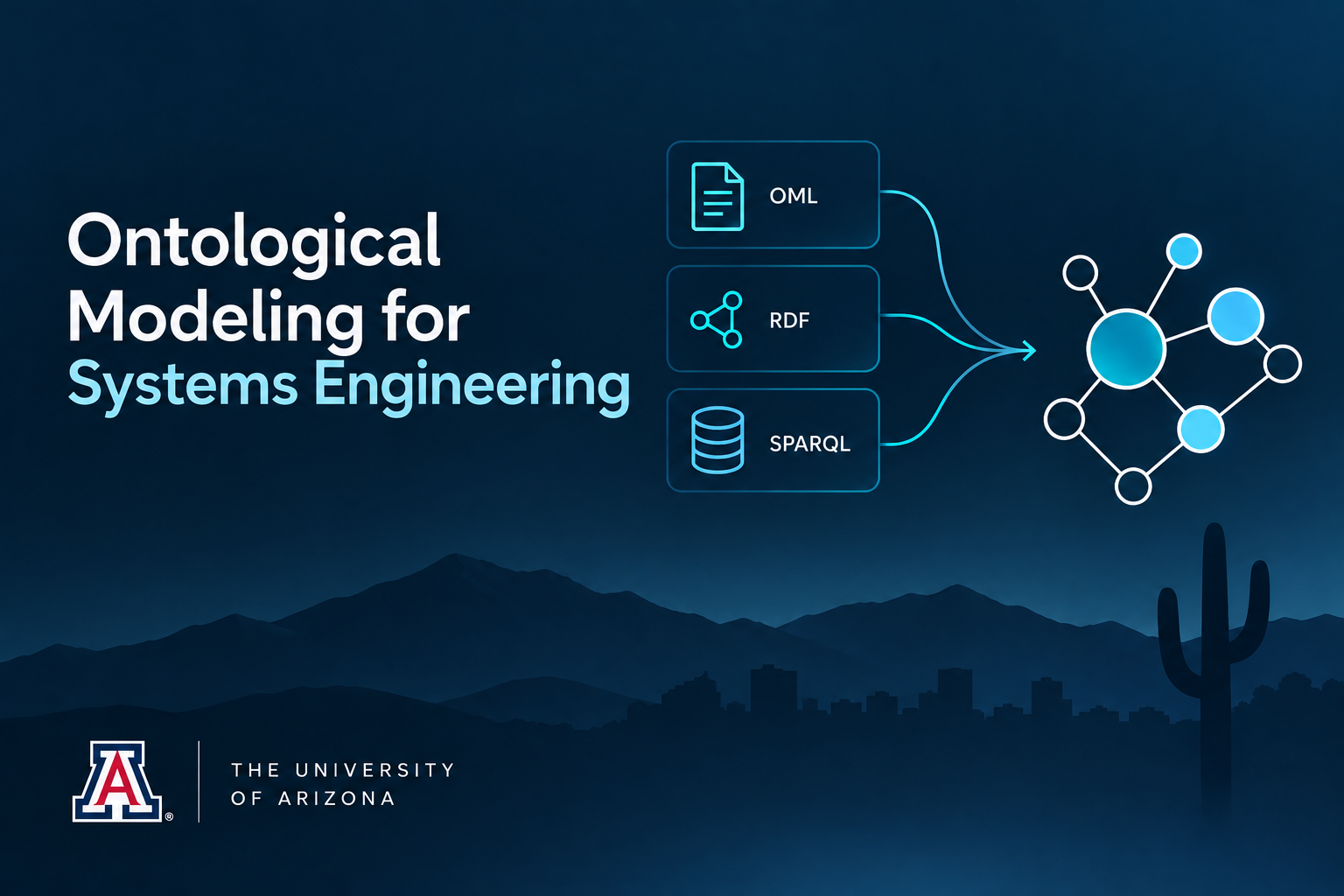
Modelware is teaching this graduate course at the Department of Systems and Industrial Engineering at the University of Arizona in Fall 2026. To our knowledge it is one of the first anywhere to treat ontological modeling as a core systems engineering competency rather than as a specialist topic in knowledge representation.
The premise is one we have argued for a while: a model that a machine can reason on is a different kind of artifact from a model that can only be drawn and reviewed. The course teaches the semantic web stack as working engineering technology rather than as background theory, with OML for authoring engineering ontologies, RDF as the underlying representation of linked knowledge, SPARQL for querying and analyzing a model, and OWL and SHACL for reasoning and validation.
Coursework is hands-on, and students run this stack themselves rather than reading about it. They author ontologies, query their own models, and put reasoners to work on them, so an inconsistency is something they hit and have to explain rather than something described in a lecture. That experience is hard to get any other way: the gap between a model that looks right and a model that holds up under inference is not obvious until a reasoner shows you.
In the course project, students build their own systems engineering methodology and then use it to model and analyze a system of their choosing. Having to live with a methodology you defined yourself is the fastest way we know to learn what makes one good.
Teaching this material has a way of exposing which parts of a practice are genuinely hard. Students pick up the syntax quickly; what takes real work is deciding what a concept means precisely enough that a reasoner can act on it, and that difficulty is the discipline itself rather than an obstacle to it. It is also the part that Neurosymbolic Systems Engineering makes newly practical, since an assistant can carry much of the formalization burden once the vocabulary is fixed.
Our thanks to the faculty at Arizona's Systems and Industrial Engineering department for building the course into their graduate curriculum. If your university is considering something similar, Modelware delivers this material as a teaching partner: get in touch.