Model-based systems engineering made a simple promise: replace the pile of documents with a model, and let the model be the authoritative source of truth about the system. Two decades in, most programs have a model. Far fewer have a model that software can actually check. The typical MBSE model means what its tool and its team’s conventions say it means, which is enough to draw diagrams and pass reviews, and not enough to ask a machine whether the model is right.
Ontology-based MBSE is the approach that closes that gap. This article explains what it is, how it differs from the MBSE most teams practice today, and why it has become practical now.
Three ways to hold engineering knowledge
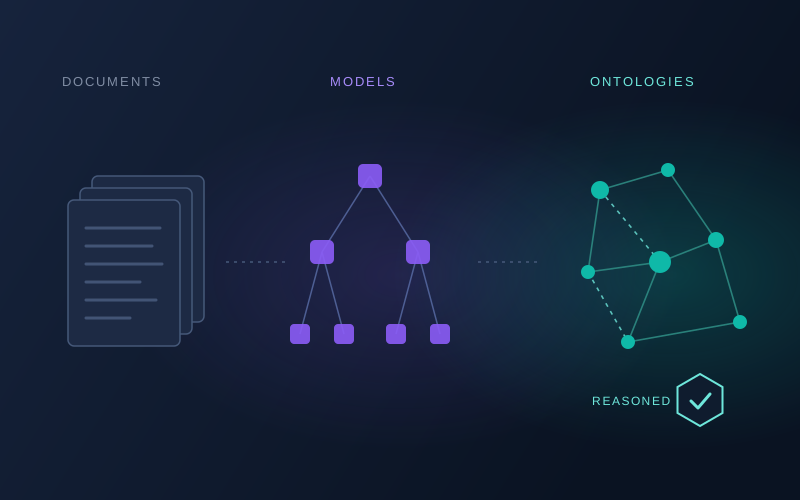
It helps to place ontology-based MBSE on a short timeline.
Document-centric engineering keeps knowledge in prose, spreadsheets, and slides. It is flexible and familiar, and it cannot be checked by anything except a human reader. Consistency across documents is a matter of diligence.
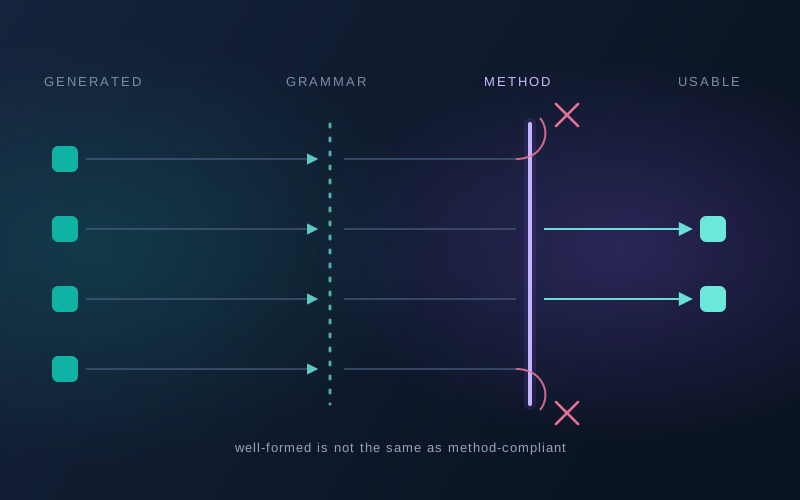
Tool-centric MBSE moves that knowledge into a modeling tool, usually with a language such as SysML. This is a real step forward: elements have identity, relationships are explicit, and views are generated rather than redrawn. But the tool validates structure, not meaning. It will tell you a model is malformed. It will not tell you that a well-formed model contradicts itself, because the meaning of most elements lives in naming conventions, stereotypes, and the heads of the people who defined them.
Ontology-based MBSE gives that meaning a formal home. The concepts your method depends on (what a component is, what it means to perform a function, which things can never be the same thing) are written down as an ontology with a logical semantics. The system model is then a set of statements in that vocabulary. Because the semantics are formal, a reasoner can derive what the model implies and detect when it contradicts itself, without anyone writing a custom rule for each case.
The shift is not from one notation to another. It is from models that describe a system to models that software can understand.
Two layers: the method and the system
Ontology-based MBSE separates two things that most MBSE tools blur together.
The first is the vocabulary: the concepts, relations, and rules of your engineering method. This is where an organization says what a Spacecraft is, that every Component may perform Functions, and that a function is never itself a component. The vocabulary is authored once by method engineers and reused across programs.
The second is the description: the facts about a particular system, stated in that vocabulary. This is where a program says that its orbiter is a spacecraft and performs attitude control.
In OML, the Ontological Modeling Language, these are literally two kinds of files. A simplified sketch looks like this:
vocabulary <http://example.com/mission#> as mission {
    concept Component
    concept Spacecraft < Component
    concept Function

    relation entity Performs [
        from Component
        to Function
        forward performs
    ]
}

description <http://example.com/orbiter#> as orbiter {
    uses <http://example.com/mission#> as mission

    instance orbiter : mission:Spacecraft [
        mission:performs attitude-control
    ]
    instance attitude-control : mission:Function
}
Nothing in the description says the orbiter is a component. The reasoner concludes it anyway, because the vocabulary says every spacecraft is one. And if someone later types attitude-control as a component as well, the reasoner reports the model inconsistent: once the vocabulary is closed in a vocabulary bundle, OML treats concepts that share no taxonomy, such as components and functions, as disjoint. No one had to anticipate that particular mistake. It follows from the semantics.
That separation is what makes the approach scale. The method is encoded once, declaratively, and every program that uses it inherits the same checks.
What it makes possible
Formal semantics are not the goal. They are what make four practical capabilities fall out of the same model.
Validation that goes beyond structure. A description-logic reasoner checks the entire model for consistency and computes its entailments, the facts it implies but never states. Errors that only appear when several individually correct statements combine are caught automatically. We showed this on a JAXA SysML model in our work on validating SysML models with a reasoner, and the underlying idea is explained in what the reasoner knows that you did not write down.
Questions with complete answers. Because an ontology-based model is a knowledge graph, it can be queried with standard languages such as SPARQL. The answers include not only what was asserted but everything the reasoner entailed. A question such as “which components perform a safety-critical function” returns the complete set, including the ones nobody labeled by hand.
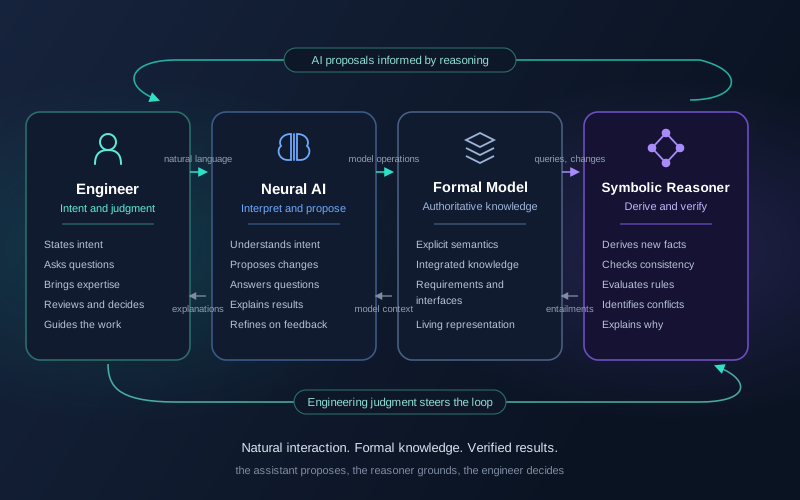
AI that is grounded, not guessing. A language model working over documents can only guess at what the engineering means. Working over a formal model, an AI assistant can look up facts, propose changes, and have every proposal checked by the reasoner before it lands. The ontology becomes a contract between what AI suggests and what logic can verify, which is the core of neurosymbolic systems engineering.
Engineering knowledge managed like code. A textual, modular model lives naturally in Git. Changes are reviewed in pull requests, and a CI pipeline can run the reasoner on every commit, so an inconsistency is caught the moment it is introduced rather than at the next milestone review. Documents and reports can be generated from the model, so they are always current.
Why it did not happen sooner
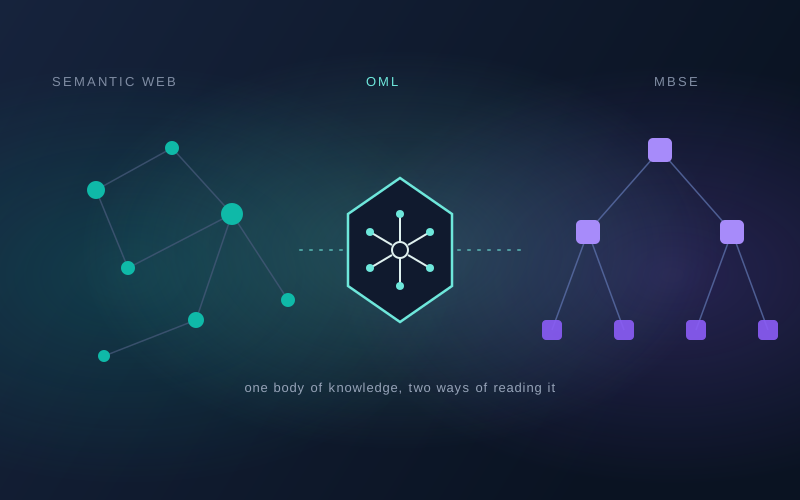
The idea of using ontologies in systems engineering is not new. Semantic Web standards such as OWL and SPARQL have existed for two decades, and the fit with MBSE has been obvious for almost as long. Adoption stayed thin for two concrete reasons, which we describe in more detail in the Semantic Web and MBSE are solving the same problem.
The first was language fit. General ontology languages were built for the web, not for engineers. They lacked the modularity, the textual workflow, and the tooling that engineering teams expect, and they left open-world questions (can these two things be the same?) unanswered in ways that surprised engineers used to closed schemas.
The second was methodology. Handing a team OWL and a reasoner does not tell them how to structure vocabularies, where the method ends and the system begins, or what the build should check. Without that practice, every team reinvented it, and most gave up.
OML was designed to address both: a language built for engineering with an OWL 2 DL semantics underneath, and a methodology for layering vocabularies and descriptions that has been exercised on real programs at NASA, JAXA, Leonardo, and in academia. What has changed more recently is cost. Modern tooling and AI assistance make formal models far cheaper to author than they were, which moves ontology-based MBSE from a specialist practice to a realistic default.
Common misconceptions
“It means abandoning SysML.” It does not. SysML models can be represented in OML and checked by a reasoner, and standards built on SysML can be rendered as ontologies. Our ontological implementation of UAF cross-checked the UAF metamodel against its SysML-based profile. Ontology-based MBSE is about giving models formal meaning, whichever notation engineers use to view them.
“Ontologies are academic.” The reasoning technology is mature and the standards are stable. The missing piece was engineering-grade language design and methodology, and that now exists.
“Open-world reasoning is useless for engineering checks.” Engineering needs certain closed-world guarantees, such as knowing that two concepts are distinct. OML provides them by design: closing vocabularies in a bundle makes unrelated concepts disjoint, so a model can be checked for the mistakes engineers actually make.
“An ontology is just a metamodel with a different name.” A metamodel defines what a well-formed model looks like. An ontology also defines what a model means, precisely enough that a machine can derive consequences and find contradictions. That difference is exactly the gap between structural validation and semantic validation.
How to start
Ontology-based MBSE does not require a big-bang migration. The teams that succeed usually start small:
- Pick one question your current model cannot answer reliably, such as traceability completeness, interface consistency, or which components realize a capability.
- Model only the vocabulary that question needs, a handful of concepts and relations, reusing an existing method where one exists.
- Describe one subsystem in that vocabulary, by hand, by import, or with AI assistance.
- Run the reasoner in CI so every change is checked, and let the checks earn trust before expanding scope.
Each step delivers something useful on its own, and each one makes the next cheaper.
For teams that want to build these skills together, our Neurosymbolic Systems Engineering training program covers the whole path, from first vocabulary to reasoning, analysis, governed AI assistance, and models at scale, through hands-on exercises and a full project with feedback. It runs asynchronously, live online, or onsite.
Want to see ontology-based MBSE running on a real model? Explore OML Code or talk to us.